
Resources
Free tools and plain-language guides on narcotic reconciliation and controlled-substance recordkeeping for Canadian pharmacies.
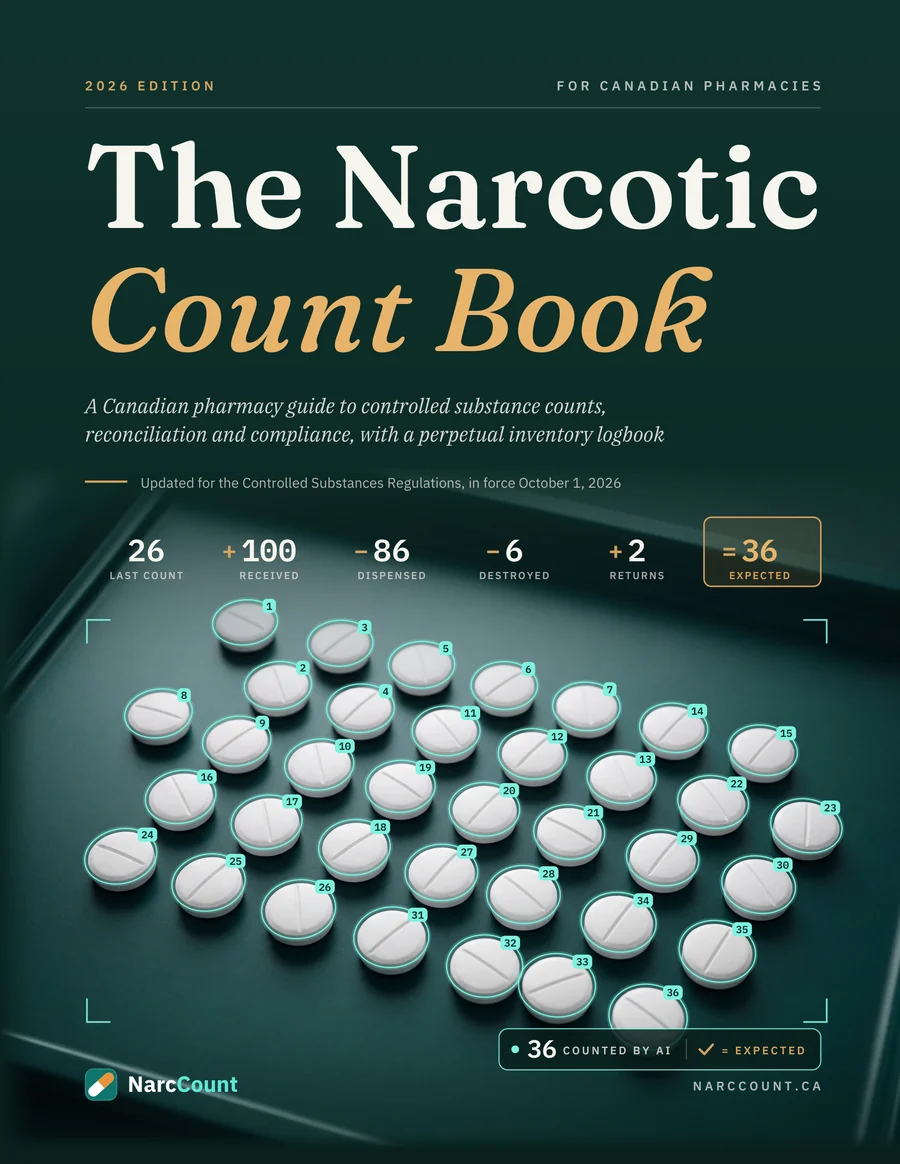 Free guideThe Narcotic Count BookCounts, reconciliation and compliance for Canadian pharmacies, in 18 chapters. Part One free by email.Get the free guide →
Free tools
- Free tool
Free controlled substance count sheet and log (PDF)
Printable count sheets, a perpetual-inventory log, a shift-change sheet, a methadone log in mL and a destruction record with its joint declaration, for Canadian pharmacies. Free, no sign-up.
Open the tool → - Free tool
Narcotic count cost calculator
Works out what a manual narcotic count costs a pharmacy per year in staff time, from your own count frequency and wage figures.
Open the tool → - Free tool
Narcotic count inspection quiz
Five multiple-choice questions on a pharmacy's narcotic and controlled-substance count rules, built from what the Ontario College of Pharmacists and Health Canada ask for. A score, the right answers and why. Free, no sign-up.
Open the tool → - Free tool
Controlled substances practice questions
Multiple-choice practice questions on Canada's controlled-substance rules, for pharmacy students and technicians: loss and theft reports, records, destruction, technicians, transfers, storage and count intervals. The right answers, why, and the guide behind each. Free, no sign-up.
Open the tool → - Free tool
Controlled substance tracking software for Canadian pharmacies
What controlled-substance tracking software has to do in Canada, and how to evaluate one.
Open the tool → - Free tool
Free medication incident report form - Ontario AIMS 15 fields
A free worksheet for Ontario's fifteen mandatory medication incident fields: fill it in, print the record, or copy it into whichever AIMS platform the pharmacy uses. No account, and nothing typed leaves the browser. It is a capture aid, not a reporting platform, and it submits nothing to the National Incident Data Repository.
Open the tool → - Free tool
Free Health Canada loss or theft report helper
A free helper for Health Canada's Loss or Theft Report Form (CS-FRM-011): type the details in the form's order, see the reporting deadline from the date of discovery, then print the draft or copy it into Health Canada's portal. Nothing typed leaves the browser, and nothing is sent.
Open the tool → - Free tool
Free DIN lookup: is this DIN a narcotic?
Type a Canadian DIN or brand name and see the product, its company, its federal controlled-substance schedule (narcotic, controlled drug, targeted substance) and whether it is marketed or cancelled, read live from Health Canada's Drug Product Database. Free, no sign-up.
Open the tool →
Guides
Narcotic reconciliation software in Canada
The tools a Canadian pharmacy can buy, each described from its vendor’s own page, and six questions to ask before you sign. NarcCount is listed first and disclosed as ours; nothing is ranked.
Read the guide →A narcotic reconciliation, worked end to end
One drug, one six-month window, and three real causes of a variance worked through to zero.
Read →Narcotic counts for Alberta pharmacies
Alberta’s standard in plain words: an audit at least every three months, and again when the licensee or owner changes.
Read →What to do after a narcotic discrepancy: a step-by-step
A controlled substance didn't reconcile. Here's a calm, methodical way to find the cause — and know when a loss actually has to be reported.
Read →How often must Ontario pharmacies count narcotics?
Ontario's OCP expects narcotics reconciled every six months. Nova Scotia and PEI monthly; Alberta, BC, Saskatchewan, Manitoba and Newfoundland every three.
Read →Health Canada loss or theft reporting: a step-by-step for pharmacies
Health Canada's Loss or Theft Report Form (PDF) and filing portal, linked, plus 5 steps: confirm the loss, report within 10 days, gather details, who submits.
Read →CDSA recordkeeping: what to keep, and for how long
At least 2 years federally (Controlled Substances Regulations s. 123(1)); at least 10 years in Ontario (O. Reg. 264/16 s. 21). What to keep, and in what form.
Read →Preparing for a narcotics inspection: a pharmacy checklist
An inspector may ask to see how you manage controlled substances. A little preparation makes it routine — here's a practical checklist.
Read →Is a narcotic discrepancy reportable? Loss vs. theft vs. an explained variance
Not every count discrepancy is a reportable loss. What decides it is whether the stock is really gone, not whether the count came out high or low.
Read →How Long Does a Pharmacy Keep Records in Canada?
In Ontario, at least 10 years from the patient's last pharmacy service, not the Rx date. Federally, at least 2 years for controlled-substance records.
Read →Controlled Substance Inventory Frequency in Canada
Narcotic reconciliation intervals by province, from monthly in Nova Scotia and PEI to twice a year in Ontario, and how to run each count well.
Read →Drug Diversion Within a Pharmacy: Definition, Warning Signs and Response
What drug diversion inside a pharmacy looks like, how to tell it from a record error, the patterns worth watching, and the controls that deter it.
Read →Narcotic Log Book Template: Columns, Worked Entries and Corrections
The columns a narcotic log book needs, a worked page of entries, what separates a good entry from a weak one, and how to correct a mistake.
Read →Methadone Accountability Log: Reconciling by Volume
How pharmacies keep a methadone balance in mL: a worked daily log, normal measurement variance, pump calibration checks, and witnessed and carry doses.
Read →Perpetual Inventory System Example for Pharmacies
A worked perpetual inventory example for a narcotic, the formula behind it, why balances drift, and how to keep a spreadsheet version honest.
Read →Narcotic Destruction Records in a Canadian Pharmacy
How destruction and waste of narcotics and controlled substances is documented in Canadian pharmacies, how long records are kept, and how it affects reconciliation.
Read →Narcotic Monitoring in Ontario Pharmacies: Records and Counts
How narcotic and controlled-substance records and reconciliation work in an Ontario pharmacy, with a worked example, common variance causes and what NarcCount does.
Read →Controlled Substances Regulations: Counts, Records and Loss Reporting
On October 1, 2026, the Controlled Substances Regulations replaced the Narcotic Control Regulations. Here is what changed for counts, records and loss reports.
Read →Pharmacy Technicians and Controlled Substances in Canada
Technicians now receive, compound, transfer, destroy and deliver controlled substances in their own right. Ordering and dispensing stay with pharmacists.
Read →Ordering and Receiving Controlled Substances in a Pharmacy
Only a pharmacist orders controlled substances, in their own name. A pharmacist or technician receives them, and the arrival date goes on the record.
Read →Central Fill of Controlled Substances in Canadian Pharmacies
A pharmacy can now central fill another pharmacy's controlled-substance prescriptions without a dealer's licence. The conditions, the order and Ontario's policy.
Read →Controlled Substance Prescription Transfers and Extensions
Since October 1, 2026, a narcotic prescription can be transferred any number of times within 2 years of first receipt, and a pharmacist can extend it.
Read →Destroying Controlled Substances in a Pharmacy: Who Can Witness
Under the Controlled Substances Regulations a technician can destroy, and the witness can be a technician, intern or other health professional.
Read →Pharmacy Delivery of Controlled Substances: Rules and Records
A pharmacist or technician can deliver controlled substances by a tracked method to the patient or their designate, never by mail. What the record holds.
Read →Low-Dose Codeine Products in Canada: The Pharmacy Rules
A pharmacist can sell low-dose codeine without a prescription under set conditions. Its receipt is still recorded and its inventory still tracked.
Read →Storing Controlled Substances: Security Requirements for Pharmacies
How a pharmacy stores controlled substances under the Controlled Substances Regulations, what Health Canada adds, and Ontario's time-delayed safe policy.
Read →Prescriber Verification and Forged Prescriptions: Pharmacy Rules
How a pharmacy confirms the prescriber behind a controlled-substance prescription, and when a forged prescription becomes a report to Health Canada.
Read →Advertising Controlled Substances: The Rules for Canadian Pharmacies
The Controlled Substances Regulations bar advertising controlled substances to the public, websites and social media included. What is allowed, and to whom.
Read →Shift Change Narcotic Count Sheet for Canadian Pharmacies
A printable shift change narcotic count sheet for Canadian pharmacies, with the columns explained, a worked example and the usual causes of a variance.
Read →Narcotic Count Procedure and Policy for Canadian Pharmacies
How a written narcotic and controlled substance count procedure is built in a Canadian pharmacy: the sheet, a worked variance example, and common causes.
Read →Targeted Substances in Canada: What They Are and How to Track Them
What targeted substances are in Canadian pharmacy practice, how they differ from narcotics, and how a pharmacy tracks them with a worked count example.
Read →